Hawkr · Unboxing

On-demand printed fan merch on clothes they already own. No new stock. No waste. No t-shirts size medium slowly turning into mouse bedding in the back corner of a warehouse.
- Year
- 2025
- Duration
- ~3 months
Built with
- Shopify custom app development
- PHP API integration
- Webhook architecture
- Artist dashboard UX
- Carbon impact reporting
- Commission/profit-split calculations
- Role
- Department of one
- Worked with
- Hawkr’s "other" guy
- Hardest part
- Fulfilment gymnastics
- Backed by
- Innovate UK grant
The brief
Band merch has a logistics problem nobody talks about. A label prints a few thousand shirts, trucks them to a venue, sells what it can, trucks the rest to the next gig, and repeats until whatever's left gets written off. Factor in returns, unsold stock, and the carbon cost of moving boxes of cotton around the country and it starts looking properly daft.
Hawkr's answer: skip the new garments entirely. Fans bring clothes they already own, the artist's design gets printed onto them. The concept works at live events - Hawkr already runs a PHP portal that handles artist registration, product creation, and fulfilment for concerts. Innovate UK backs them with a grant to build a Shopify app and take it online.
That's where I come in. I run the whole project - pitch, spec, design, build, QA, app store submission. I coordinate with Hawkr's existing portal developer on the API contract and handle everything on the Shopify side. One person, zero handoffs.
Before
Traditional merch
- Print a few thousand shirts up front
- Truck stock from venue to venue
- Eat the cost of whatever doesn't sell
- Process returns and sit on dead inventory
After
Hawkr Zero
- Nothing printed until a fan places an order
- Fan brings their own garment
- Zero speculative stock, zero returns
- Artist sees the carbon saved on every order
What I built
I built the Shopify app that bridged Hawkr's existing PHP portal and any installing artist's Shopify store. Artists pull their Hawkr-created designs into Shopify in one click. Orders placed through Shopify get pushed back to Hawkr for fulfilment via new API endpoints and webhooks I specced with Hawkr's engineers.
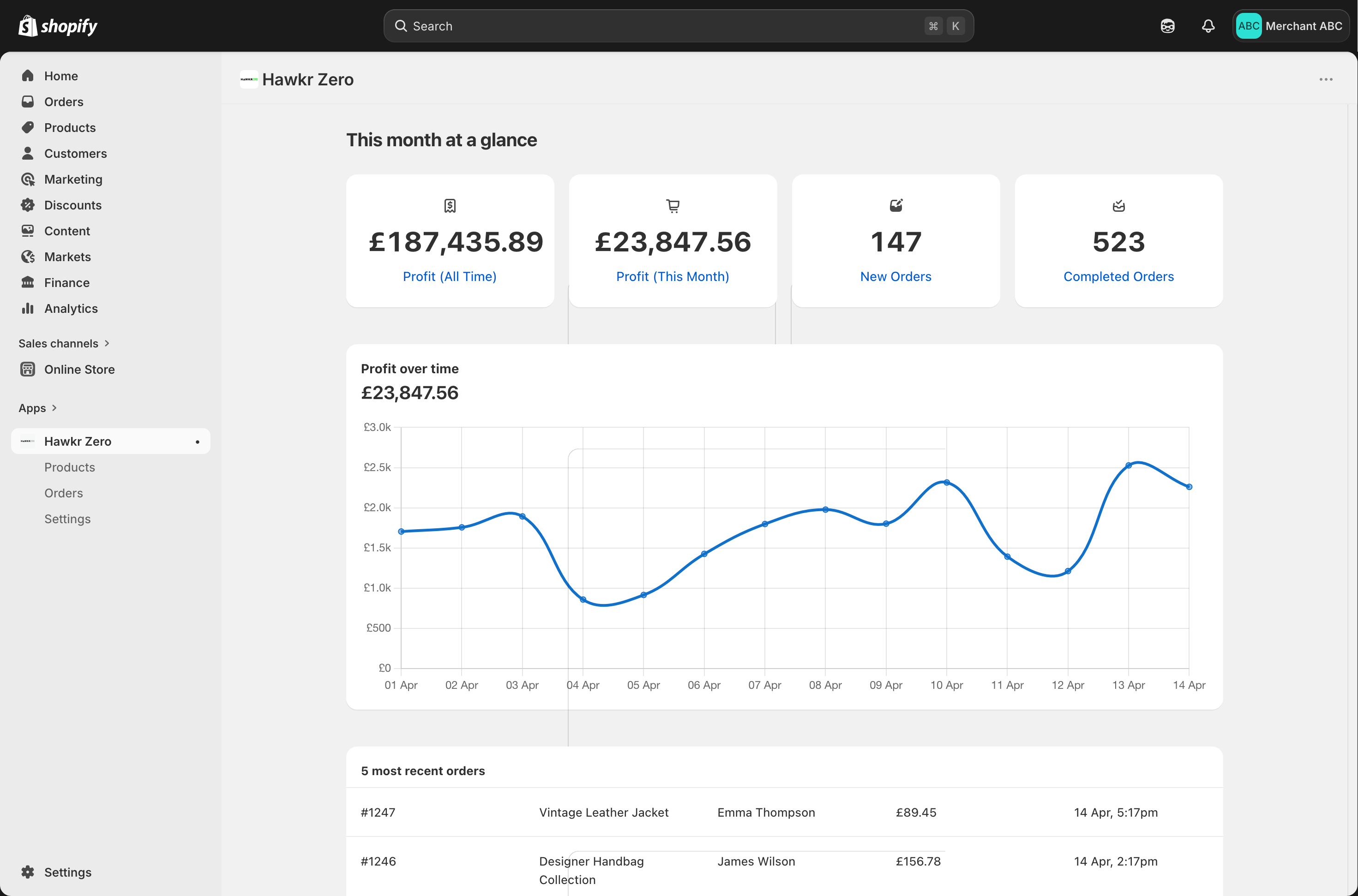
Inside Shopify, the artist's dashboard shows current orders, the commission split as pound values rather than percentages, and the carbon difference between each Zero Merch order and a traditional print run.
Shipped on the date he'd quoted, with everything we'd asked for. The grant milestone took care of itself.
- Jamie Monson (Hawkr founder)
How the project ran
- 01 Nov 2024
Pitch
Scope and approach agreed with Hawkr.
- 02 Dec 2024
Kickoff
Spec, wireframes, and API contract drafted.
- 03 Dec 2024
Design
Artist dashboard and merchant install flow.
- 04 Jan 2025
Build
Shopify app, Hawkr integration, and webhooks.
- 05 Jan 2025
QA
End-to-end runs against the Hawkr portal.
- 06 Feb 2025
Live
Real sales at a real gig.
Under the hood
- Double-OAuth install flow: Shopify app auth and Hawkr portal auth handled in a single merchant onboarding journey.
- Hawkr's three-leg fulfilment flow mapped onto Shopify's single-outbound-shipment order model, with customer-facing status emails at each leg.
- One-click import of Hawkr-built designs into Shopify with product metadata preserved.
- Artist dashboard built as an embedded Shopify admin surface, so artists don't have to leave their store to check orders, commission, or carbon impact.
- Contract-tested webhook and API integration between Shopify and the Hawkr portal.
What shipped
Phase one shipped at the end of January, on schedule for Hawkr's Innovate UK grant milestone. It ran live at a gig in February with a real artist, real fans, and real sales. That was the first time the Hawkr Zero model had been deployed through Shopify.
The result is a Shopify app any artist on Shopify can install, plug into Hawkr, and start offering print-on-fan-clothing merch alongside their existing catalogue. Hawkr gets to open their model up to a market segment their PHP portal couldn't reach, without rebuilding the back end.
Questions & answers
Why a Shopify app instead of a theme integration?
Who owned the API design?
What was the hardest part?
Can this be adapted for a different client?
Want this for your store?
The services that built Hawkr Zero, available as a bundle.
Product 01
Custom App Development
When off-the-shelf apps don't cut it.
From £12,000
Product 02
Ongoing Support & Maintenance
A developer on retainer. Like having a CTO, but affordable.
From £2,000/month
Bundle total
From £14,000
★★★★★ Would build again
"Shipped on time for the gig it was built for."